
ILO
Quick Search
Show me:
World Employment and Social Outlook - Trends 2025
Paperback
- Author:
- International Labour Organisation (ILO)
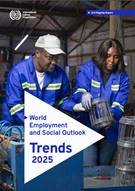
Strong headline employment indicators hide persistent structural weaknesses on global labour markets. Although unemployment has stabilized at a historical low, informal employment, gender gaps and working poverty have shown little or no improvement following the return to pre-pandemic trends. Lacklustre productivity growth in major economic markets in Europe and Asia amidst slowing structural transformation towards manufacturing and high-value-added services is also preventing the recovery of real disposable incomes from the losses incurred during the most recent inflationary period.
Manufacturing, once a driver of economic growth and productive employment, has experienced a protracted period of stagnation, which has exacerbated spatial inequalities both within and across countries. On current trends, no further improvements in decent work from the 2015 baseline are to be expected by 2030.
The report provides a comprehensive assessment of structural imbalances in labour markets alongside the ongoing transformation of the global economy. It analyses global patterns, regional differences, and outcomes across groups of workers. For the first time, it offers an analysis of subnational trends in selected countries. It also offers labour market projections for 2025 and 2026. Finally, it presents trends in labour force participation, employment growth, and informality and analyses their contributions to structural labour market deficits.
Key messages
-
The global economy continues to grow at a moderate rate, but growth is expected to slow gradually, limiting a stronger and more sustained labour market recovery.
-
Inflation declined during 2024 and moved closer to the target rates set by most central banks.
-
Despite falling inflation, wage growth has not fully recovered the earnings lost during the pandemic, partly because of weak employment growth.
-
Labour force participation has declined slightly, contributing to slower employment growth.
-
Women remain significantly less likely than men to participate in the labour market, meaning countries are missing opportunities to increase employment and improve living standards.
-
Global unemployment rates remained relatively stable in 2024.
-
The global jobs gap, the ILO?s estimate of the total number of people who want work but do not have a job, stood at approximately 402.4 million in 2024.
-
Other social indicators have shown little improvement since 2015.
-
Slowing productivity growth remains a major barrier to expanding access to decent work.
-
Increased investment in green energy and sustainable mobility has led policymakers to place greater emphasis on these areas within industrial policy.
| Extent | 65 pages | ISBN | 9789220411575 |
|---|---|---|---|
| Size | A4 | Price | £22.00 |
| Format | Published | 31 Mar 2025 | |
| Availability | In Stock: 1 - 2 days
 |
Delivery | Delivery options and charges |
 Show all Subjects & Categories